
Implants • Skull Maxillofacial (CMF)
Palatal Distractor
Description
The commercial models that make up the Palatal Distractor family are defined as fixation devices, classified as a surgically invasive medical product for long-term use, for fixation in the maxillary bones.
Surgically assisted maxillary expansion is an alternative
active for the correction of transverse maxillary deficiencies. The type of anchorage of the Palatal Distractor is bone-supported, that is, its fixation must be carried out on the palatal process. Any expansion will occur due to the distance between the two jaws, without influencing the treatment regarding the number of teeth or the patient's periodontal health. This procedure was
provides space to align the teeth, and causes a widening of the apical base of the maxilla and palatal vault, providing space for the tongue and correct swallowing, in addition, there is an improvement in breathing (Lima A.N. 2011).
The design and use of the distractor are based on an understanding of bone healing and the loads and forces to which the medical device is subject. The implant was developed to withstand distraction and compression loads, thus providing structural stability and also transmitting or relieving mechanical loads on the jaw bones.
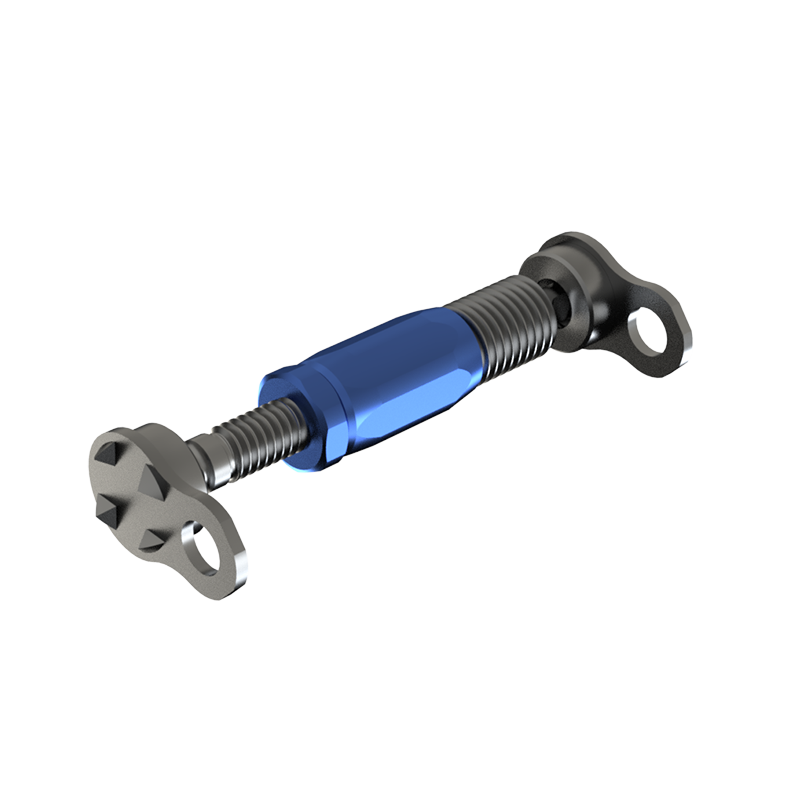
The Palatal Distractor is manufactured from Ti-6Al-4V Titanium alloy, consisting of an adjustable distraction element body, which is manually activated, and two plates with spikes that are fixed to the bone walls of the maxilla with Microfragment Screws (ancillary components).
Surgically assisted maxillary expansion is an alternative
active for the correction of transverse maxillary deficiencies. The type of anchorage of the Palatal Distractor is bone-supported, that is, its fixation must be carried out on the palatal process. Any expansion will occur due to the distance between the two jaws, without influencing the treatment regarding the number of teeth or the patient's periodontal health. This procedure was
provides space to align the teeth, and causes a widening of the apical base of the maxilla and palatal vault, providing space for the tongue and correct swallowing, in addition, there is an improvement in breathing (Lima A.N. 2011).
The design and use of the distractor are based on an understanding of bone healing and the loads and forces to which the medical device is subject. The implant was developed to withstand distraction and compression loads, thus providing structural stability and also transmitting or relieving mechanical loads on the jaw bones.
The Palatal Distractor is manufactured from Ti-6Al-4V Titanium alloy, consisting of an adjustable distraction element body, which is manually activated, and two plates with spikes that are fixed to the bone walls of the maxilla with Microfragment Screws (ancillary components).
ANVISA
80083650072
Components and codes
4 items
Indications
Transpalatal distraction is indicated to correct transverse maxillary discrepancies and dental crowding, such as: posterior crossbite, which can be unilateral or bilateral, ogival-shaped palate, loss of parabolic conformation of the dental arch (“V” shape).
Materials
Titanium Alloy ASTM F136
Components and codes
| Code | Description | ANVISA | Qty |
|---|---|---|---|
| 0182001-009 | Distrator Palatal 9 mm | 80083650072 | 1 |
| 0182001-018 | Distrator Palatal 18 mm | 80083650072 | 1 |
| 0182001-027 | Distrator Palatal 27 mm | 80083650072 | 1 |
| 0182001-036 | Distrator Palatal 36 mm | 80083650072 | 1 |